Choosing the right 1000L craft beer fermentation tank for a microbrewery is essential for maintaining beer quality, controlling fermentation temperatures, and planning production efficiently. A properly specified fermenter does more than hold wort. It must provide sufficient working volume, support the required fermentation conditions, allow effective cleaning, and integrate with the brewery's cooling and transfer systems.
For a growing craft brewery, a 1000L fermentation tank can be a practical option for producing larger batches, expanding cellar capacity, or establishing a more consistent production schedule. However, the right choice depends on the brewhouse output, beer styles, fermentation time, available floor space, and the tank's actual working volume.
At Shandong SENMO Machinery Co., Ltd., we supply customized beer fermentation equipment for microbreweries and commercial brewing projects. Our 1000L craft beer fermentation tank is available with stainless steel material options, insulation, cooling jackets, and project-specific configurations.
In this guide, we explain how to choose a 1000L beer fermenter, what technical specifications to check, how to estimate the number of tanks your brewery needs, and which purchasing mistakes to avoid.
1. What Is a 1000L Craft Beer Fermentation Tank?
A 1000L craft beer fermentation tank is a vessel used to ferment and, depending on its design, condition beer after wort has been produced by the brewhouse.
Its nominal capacity is equivalent to:
1,000 liters
10 hectoliters (hL)
1 cubic meter
Approximately 264 US gallons
For microbreweries, this capacity can support medium-sized brewing batches without requiring the space and investment associated with much larger fermentation vessels.
A 1000L fermenter may be suitable for:
Small and medium-sized commercial craft breweries.
Brewpubs expanding their on-site beer production.
Restaurants and hotels producing house beer.
Breweries introducing new recipes or seasonal beers.
Existing breweries adding fermentation capacity.
Craft beer businesses supplying local bars, restaurants, and retailers.
The critical purchasing detail is that a tank advertised as 1000L does not necessarily accept 1000L of wort as its maximum safe operating fill. Manufacturers may specify nominal vessel capacity, gross capacity, or working capacity differently.
During active fermentation, foam and krausen can occupy additional space. The required headspace depends on the beer style, yeast behavior, operating conditions, and tank design.
Before ordering, ask the manufacturer to state the nominal capacity, recommended working volume, maximum fill level, and intended operating conditions on the technical drawing.
Here’s a detailed specifications table for a 1000L craft beer fermentation tank typically used in a microbrewery:
| Specification | Details |
|---|---|
| Capacity | 1000 Liters (approx. 8.5 barrels or 264 gallons) |
| Material | Stainless Steel 304 or 316 (Food Grade) |
| Inner Tank Thickness | 3mm - 4mm (varies based on design) |
| Outer Jacket Thickness | 2mm - 3mm |
| Insulation | Polyurethane Foam, 80mm thick |
| Cooling Jacket | Dimpled Plate or Glycol Jacket (around the cylinder and cone) |
| Cooling Zones | Typically 2-3 zones for precise temperature control |
| Design Pressure | 0.2 MPa (around 2 bar) |
| Working Pressure | 0.15 MPa (around 1.5 bar) |
| Manway | Top or Side Manway (rectangular or oval) |
| Temperature Control | Thermowell for temperature sensor or probe |
| CIP Arm and Spray Ball | 360-degree coverage spray ball for efficient cleaning |
| Sampling Valve | Sanitary sampling valve for testing during fermentation |
| Pressure Relief Valve | Set at 1.5 bar for safety |
| Racking Arm | Rotating racking arm for transferring beer |
| Bottom Outlet | 1.5" or 2" tri-clamp port for yeast harvesting and complete drainage |
| Legs | Adjustable stainless steel legs with leveling pads |
| Finish | Interior: Mirror polished to Ra 0.4µm Exterior: Brushed or polished finish |
| Cooling Method | Glycol cooling with insulated jacket |
| Glycol Connection | 1" or 1.5" tri-clamp fittings |
| Dimensions | Approx. Height: 2.5-3 meters Diameter: 1.2-1.5 meters |
| Weight | Approx. 300-500 kg (varies based on configuration) |
| Certification | CE, ASME (optional), ISO |
| Optional Features | - Carbonation stone - Rotating spray ball - Sight glass - Custom fittings |
| Warranty | Typically 1-2 years on major components |
This table provides a comprehensive overview of the key specifications for a 1000L craft beer fermentation tank, detailing the materials, features, and options available to meet the needs of microbreweries.
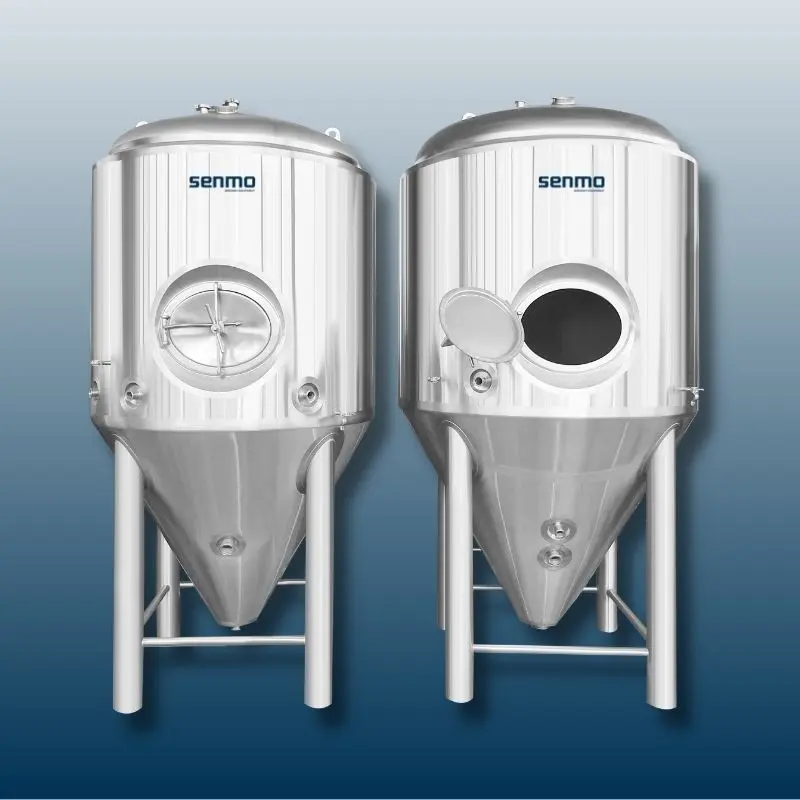
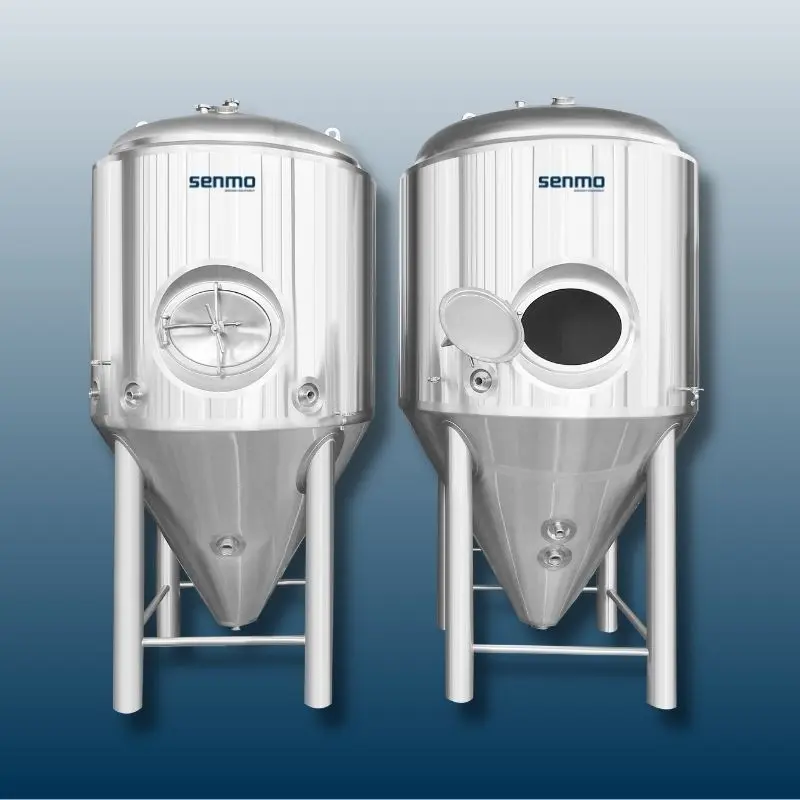
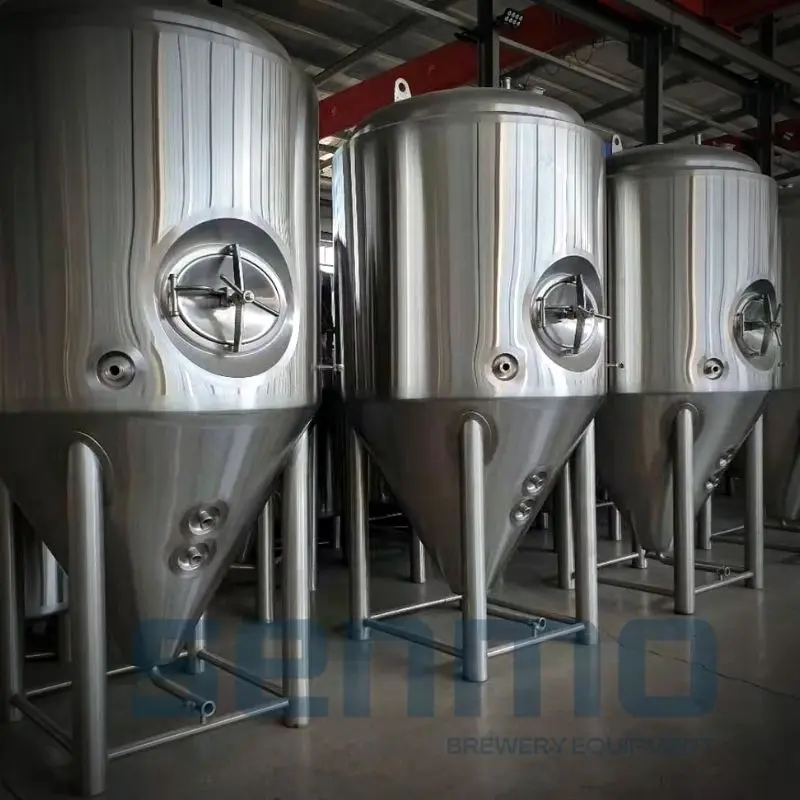
SUS304 10hl beer unitank for sale
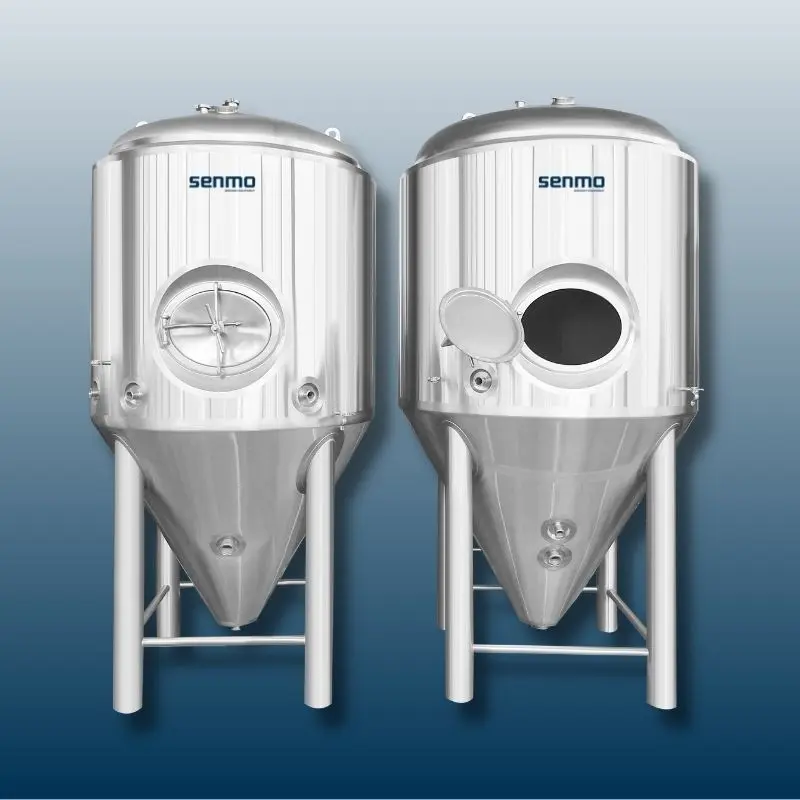
This is 1000L beer fermentation tanks for microbrewery.The manhole is on the side of the tanks,making brewers easy to clean the tank.We can also make it as Unitank,you can see the CO2 charging port on the right tank. The tanks we produced are with top quality,from the SUS304 plate to the fittings on the tanks.We can make the whole tanks by Stainless steel 316 material if you have special requirements on it.
2. SENMO 1000L Beer Fermentation Tank: Specifications and Options
SENMO's published product information describes a stainless steel fermentation tank designed for microbrewery applications, with customization available according to the project requirements.
| Specification | Published details or available options |
|---|---|
| Nominal capacity | 1000L model; product range lists 100L–30,000L per tank |
| Material | SUS304 or SUS316 stainless steel; copper exterior option |
| Inner tank thickness | 3mm, 4mm, or 5mm, depending on the model |
| Outer tank thickness | Listed as 2mm |
| Cooling arrangement | Dimple jackets around the tank wall and cone |
| Insulation | Double-wall insulated construction |
| Tank dimensions | Customized |
| Tank geometry | Conical-bottom design listed |
| Pressure-related equipment | Pressure regulation valve listed; exact pressure specifications must be confirmed |
| Pressure test | Product page lists 0.4MPa test pressure; this is not automatically the permitted working pressure |
| Warranty | Product page lists a five-year warranty; confirm the coverage and exclusions in the quotation |
These specifications are based on SENMO's published product information. The exact construction and available options should be confirmed for the selected model before ordering.
SUS304 or SUS316 stainless steel?
Both materials are used in commercial food and beverage equipment, but their suitability depends on the environment, cleaning chemicals, and operating requirements.
SUS304 stainless steel is a common choice for beer-contact surfaces because of its corrosion resistance, cleanability, and suitability for many brewing applications.
SUS316 stainless steel offers greater resistance to certain corrosive environments, particularly those involving chlorides. Whether this upgrade is justified depends on the brewery's water chemistry, cleaning procedures, and other operating conditions.
When comparing quotations, ask the manufacturer to specify the material used for the tank interior, cone, valves, fittings, and other product-contact components. Do not assume that a tank described as SUS316 uses SUS316 for every component.
What does the 0.4MPa test pressure mean?
SENMO's published product page lists a test pressure of 0.4MPa. Buyers should not interpret this as the tank's allowable working pressure or design pressure.
The following are different technical values:
Design pressure: The pressure basis used for the vessel's engineering design.
Working pressure: The permitted pressure during normal operation.
Test pressure: The pressure used during the specified pressure test.
Request written confirmation of these values, the applicable test procedure, pressure-relief device settings, and any required certifications for the destination market.
This distinction is especially important if you intend to ferment, carbonate, or condition beer under pressure.
3. Why Choose a Stainless Steel Conical Beer Fermenter?
A conical-bottom fermentation tank is widely used in commercial brewing because its shape can help collect yeast and sediment in the bottom cone.
Depending on the design and operating procedure, this allows brewers to remove settled material through a dedicated outlet without transferring the entire beer batch.
The advantages are practical rather than automatic. Performance depends on the cone geometry, outlet placement, valve arrangement, and how the brewery manages yeast and sediment.
Easier yeast and sediment management
Yeast and other solids can settle toward the bottom of the conical section. A suitable bottom outlet helps facilitate sediment removal and yeast collection where the process supports it.
The exact procedure depends on the beer style and the brewery's yeast-management practices.
More convenient beer transfer
When the tank has suitable outlets and transfer connections, brewers can move beer to a serving tank, bright beer tank, or packaging system while reducing unwanted sediment carryover.
Buyers should confirm the location of the product outlet, sampling port, valves, and any racking arrangement specified for the selected model.
Better integration with temperature control
SENMO's listed 1000L fermenter uses dimple cooling jackets around the tank wall and cone. This arrangement is intended to support heat removal through a compatible glycol or chilled-water system.
The cooling jacket must be matched to the brewery's actual cooling requirements. Tank geometry alone does not guarantee a particular cooling time or temperature uniformity.
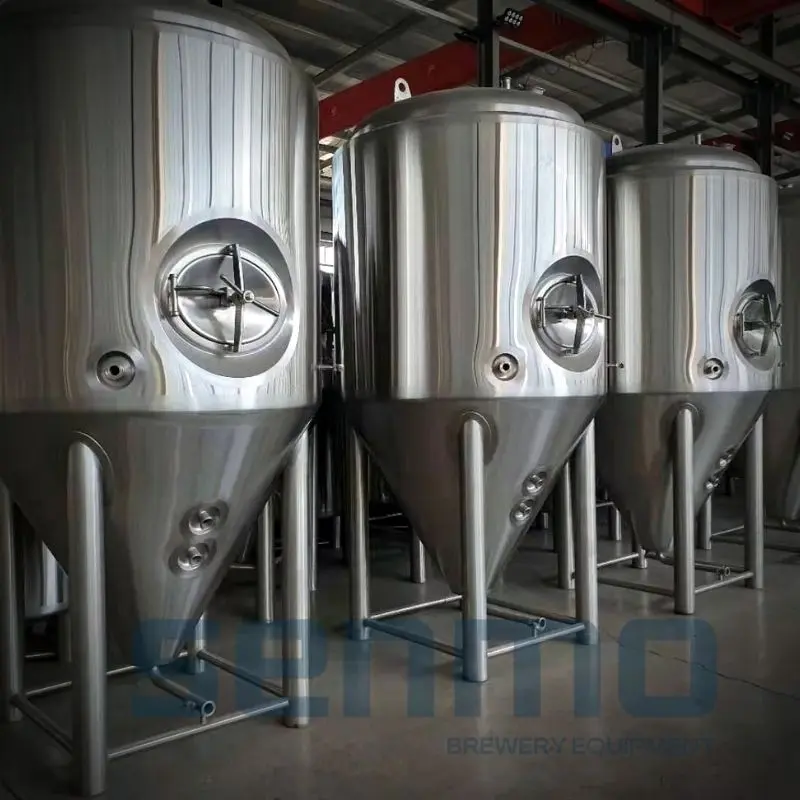
The fittings and valves will be connected on the tank before delivery,see the following list:
Mechanical pressure regulating valve
Pressure gauge
Safety valve
CIP arm and CIP ball
Beer sample valve
Beer outlet pipe on the cone
Drain outlet pipe on the bottom
Butterfly valve
4. How Do Cooling Jackets and Insulation Improve Fermentation Control?
Fermentation generates heat as yeast converts fermentable sugars into alcohol and carbon dioxide. If the heat is not removed effectively, beer temperature can rise beyond the brewer's target.
Temperature affects yeast activity and can influence fermentation speed, flavor development, and the consistency of the final product.
SENMO's listed 1000L fermentation tank uses an insulated double-wall construction with cooling jackets around the wall and cone.
Cooling jackets
The cooling jackets circulate a suitable cooling medium, typically glycol in commercial brewery systems, to remove heat from the fermenting beer.
When reviewing the design, confirm:
The cooling-jacket arrangement and coverage.
Whether the cylindrical wall and cone have separate cooling zones.
The recommended glycol supply temperature and flow conditions.
The connections and controls required for temperature regulation.
The expected cooling load when multiple fermenters operate simultaneously.
Not every fermenter requires the same jacket arrangement. The appropriate design depends on the vessel geometry, fermentation profile, and the brewery's cooling system.
Polyurethane insulation
Insulation reduces unwanted heat transfer between the tank and its surroundings.
This can help stabilize temperature and reduce unnecessary cooling demand, although actual energy performance depends on the insulation specification, ambient conditions, and operating schedule.
Ask for the insulation material and thickness in the final technical documents rather than assuming that all 1000L tanks use the same insulation construction.
Sizing the glycol chiller
One of the most common planning mistakes is choosing a chiller based solely on the total nominal volume of the fermentation tanks.
For example, a brewery with four 1000L fermenters does not necessarily require a chiller sized by simply multiplying 1000L by four and selecting a unit with a matching number.
The cooling system must account for the heat generated during fermentation, the initial beer temperature, target temperature changes, ambient conditions, insulation, and the possibility that several tanks will require cooling simultaneously.
For reliable sizing, prepare a cooling-load calculation based on the planned production schedule and operating conditions.
The Brewers Association provides additional technical resources on brewery cooling and process engineering through its Engineering Resource Hub.
5. How Much Beer Can a 1000L Fermentation Tank Produce?
The actual output of a 1000L fermenter depends on its working volume, fermentation process, transfers, and packaging losses.
A nominal 1000L capacity should therefore be treated as a starting point for planning, not a guarantee of finished beer output.
Consider a hypothetical brewery that obtains 900L of packaged beer from a batch intended to produce 1000L. Under that assumption:
| Calculation | Result |
|---|---|
| Nominal batch volume | 1,000L |
| Illustrative packaged output | 900L |
| Illustrative yield against nominal batch volume | 90% |
| 500mL servings | 1,800 |
| 330mL servings | Approximately 2,727 |
The 900L packaged output and 90% yield are illustrative calculations, not measured SENMO equipment performance. A real brewery should replace them with its own expected working volume and process losses.
Actual losses can arise during wort transfer, trub separation, yeast removal, conditioning, filtration where used, and packaging.
For planning purposes, distinguish between:
Wort entering the fermenter.
Beer remaining after fermentation and sediment removal.
Beer transferred to the next vessel.
Packaged or saleable beer.
This makes production estimates more useful for comparing equipment options and forecasting sales.
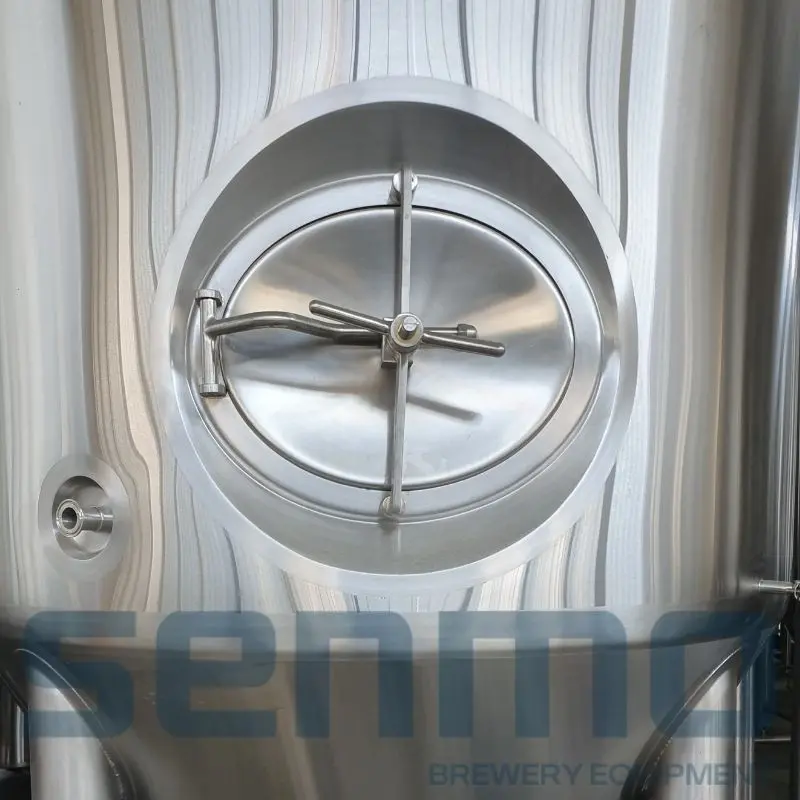
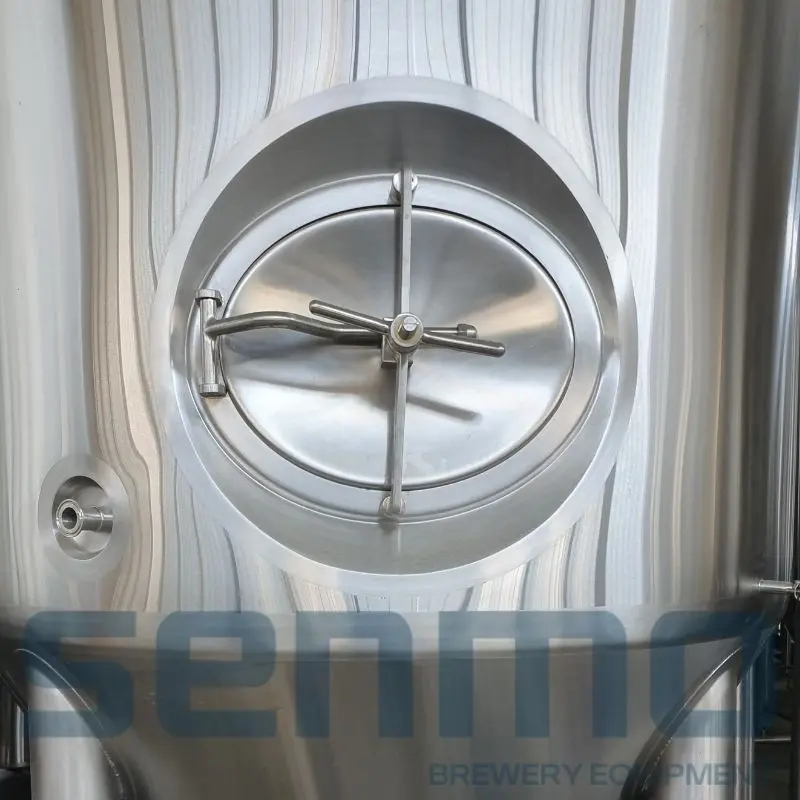
The manhole can be opend on the side of tank or on the top.The door can be opened inside of the tank or outside of the tanks.
And there is cooling jackets around the inner tanks,the cooling jacket can achieve all countries’ standard, supply Miller, arch, corrugated plate and so on. Meet all kinds of demand of cooling technology of coolant and pressure.
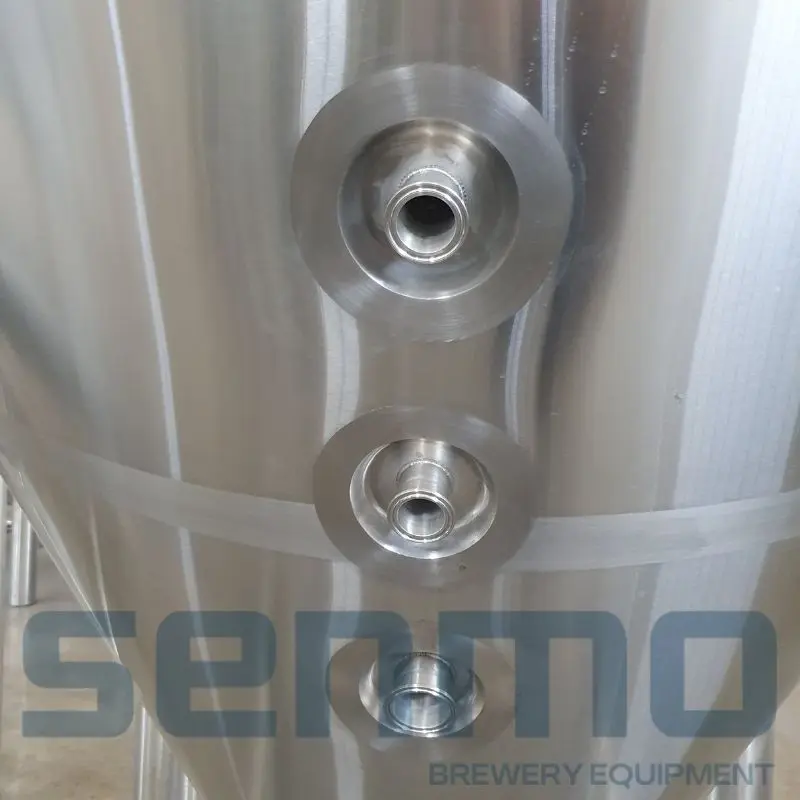
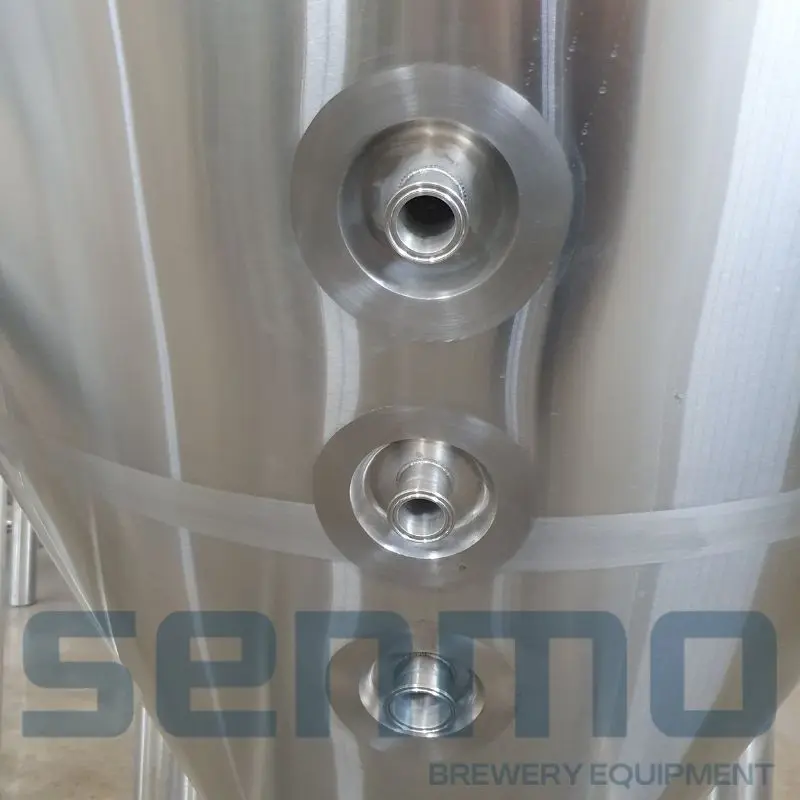
For small big unitanks for sale,the sample valve port,CO2 charging port,and beer racking arm all opened on the cone of the tanks,it makes brewers operat much easier. The size of the port can be 32mm,50mm or others as per your requirements.
6. How Many 1000L Fermenters Does a Microbrewery Need?
The required number of fermenters depends on how often the brewery brews, how much wort enters each tank, and how long each tank remains occupied.
A simplified planning formula is:
Required batch-equivalent fermentation slots = Batches started per week × Tank occupancy period in weeks
Suppose a brewery starts three batches per week and each batch occupies its fermenter for two weeks, including fermentation and conditioning.
The estimate would be:
3 batches per week × 2 weeks = 6 batch-equivalent fermentation slots.
Under these assumptions, six suitable fermentation slots would be needed to maintain that schedule before allowing for additional buffer capacity, cleaning, delayed fermentation, or different beer styles.
This is an illustrative planning example, not a universal production recommendation.
What if the brewhouse batch is smaller than 1000L?
A brewery may use a 1000L fermenter for a smaller batch, provided the working volume and process requirements suit the tank.
However, buying a larger tank than necessary can affect capital utilization, scheduling, and temperature-control requirements. It may also leave some capacity unused for long periods.
What if the brewery plans to expand?
For a growing brewery, adding fermentation tanks can be a practical way to increase production capacity without immediately replacing the brewhouse.
Before purchasing additional tanks, check whether the existing glycol chiller, transfer pumps, electrical supply, piping, and cleaning system can support the additional capacity.
The most useful investment is the one that removes the actual production bottleneck, not necessarily the one that adds the greatest nominal tank volume.
7. Practical Purchasing Experience: Six Mistakes to Avoid
Equipment selection becomes easier when buyers look beyond the tank description and consider how the vessel will operate in a real brewery.
Mistake 1: Confusing gross capacity with working capacity
A supplier may list 1000L without clearly explaining the usable volume.
This can create problems when your brewhouse transfers a batch that leaves insufficient headspace for active fermentation.
Our recommendation: Request the maximum recommended fill level and working-volume specification in writing. Confirm that it suits your recipes and fermentation behavior.
Mistake 2: Selecting the chiller too late
The fermenter may fit the available room and match the required capacity, but the existing glycol system may not have enough capacity to cool several tanks simultaneously.
Our recommendation: Plan the fermenters and the cooling system together. Provide the supplier with the number of tanks, intended fermentation profiles, and expected simultaneous cooling demand.
Mistake 3: Treating a pressure test as an operating-pressure rating
A pressure-test value does not, by itself, establish the vessel's permissible operating pressure.
This distinction matters for breweries that intend to perform pressure fermentation, carbonation, or other pressurized operations.
Our recommendation: Obtain the design pressure, working pressure, pressure-relief settings, test documentation, and applicable compliance information before ordering.
For US installations, the Brewers Association's Brewery Pressure-Rated Vessels FAQ explains important pressure-vessel considerations. It notes that many brewery process vessels operating above 15psi require ASME-compliant design and fabrication, subject to applicable rules and the local jurisdiction. Buyers should verify the requirements for their actual installation location.
Mistake 4: Ignoring cleaning-system compatibility
A fermentation tank can have a stainless steel interior and still be difficult to clean if the spray coverage, drainage, connections, or cleaning procedure are unsuitable.
Our recommendation: Check the CIP arrangement, cleaning flow rate, pressure, spray-device compatibility, drainability, and the presence of potential product-retention areas.
The cleaning procedure should be designed for the vessel and validated under the brewery's operating conditions.
Mistake 5: Forgetting ceiling and maintenance clearance
Tank dimensions are not just a floor-plan issue. The top of the tank may require access for dry hopping, instrumentation, cleaning connections, and maintenance.
Our recommendation: Confirm overall tank height, overhead clearance, door dimensions, installation access, and the space needed for safe operation before approving the drawings.
Mistake 6: Ordering unnecessary accessories
Additional valves, instruments, or optional features may be valuable, but adding them without a clear process requirement can increase cost and maintenance complexity.
Our recommendation: Separate essential equipment from optional items. Specify the desired functions first, then select the appropriate fittings, sampling equipment, cleaning devices, and pressure-control components.
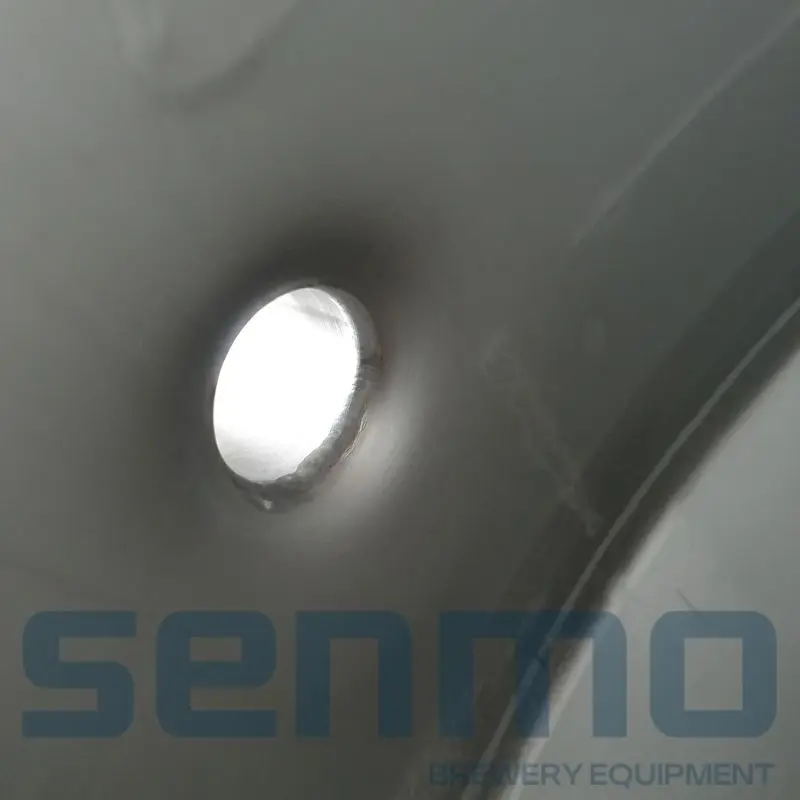
The inner surface of the tank is mirror-polished or acid passivation.Pickling and passivation treatment is usually carried out in engineering to make the corrosion resistance potential of stainless steel greater. In the process of forming, assembling, welding seam inspection (such as flaw detection, pressure test) and construction marking of stainless steel equipment and components, surface oil, rust, non-metallic dirt, low melting point metal pollutants, paint, welding slag and splash are brought, which affect the surface quality of stainless steel equipment and components and damage the oxide film on their surfaces, It reduces the overall corrosion resistance and local corrosion resistance of steel (including pitting corrosion and crevice corrosion), and even leads to stress corrosion cracking.
8. What Accessories Should a 1000L Beer Fermenter Include?
The appropriate accessories depend on the fermentation process, cleaning method, transfer system, and the intended operating pressure.
The following table is a useful purchasing checklist.
| Component | Purpose | What to confirm |
|---|---|---|
| Temperature sensor or thermowell | Monitors fermentation temperature | Sensor type, position, and compatibility with the control system |
| Cooling-jacket connections | Supplies cooling medium to the tank | Jacket arrangement, flow requirements, and connection size |
| CIP spray device or cleaning connections | Supports tank cleaning | Spray coverage and compatibility with the brewery's cleaning system |
| Sampling valve | Collects samples during fermentation | Sampling design and sanitary requirements |
| Pressure gauge | Indicates tank pressure | Pressure range and suitability for the intended operating conditions |
| Pressure-relief device | Protects against excessive pressure | Correct rating, setting, and applicable safety requirements |
| Product outlet and drain | Transfers liquid and removes residual material | Connection type, valve arrangement, and drainage |
| Top or side access opening | Provides access for inspection and maintenance | Position, sealing arrangement, and safe-access requirements |
| Insulation and outer shell | Reduces unwanted heat transfer | Insulation type, thickness, and exterior finish |
The listed SENMO tank includes a pressure regulation valve in the published product description. Other accessories and their precise specifications should be confirmed in the final quotation.
Where pressure-rated operation is required, the entire vessel and associated pressure-control system must be suitable for the intended use. Individual accessories should not be assumed to make an otherwise unsuitable tank safe for pressurized operation.
9. How to Keep a 1000L Fermentation Tank Clean and Reliable
Cleaning and maintenance affect product quality, production efficiency, and the service life of the equipment.
A consistent cleaning procedure should address the interior surface, cone, valves, sampling connections, and other areas that contact beer or process liquids.
A typical cleaning plan may involve the appropriate pre-rinse, cleaning solution, contact time, intermediate rinse, and final rinse or sanitizing steps according to the brewery's validated procedure.
The correct chemicals, concentrations, temperatures, and circulation conditions depend on the tank materials, soil load, cleaning equipment, and sanitation requirements.
Avoid assuming that a spray ball or CIP connection alone guarantees effective cleaning. Coverage and performance must be appropriate for the vessel geometry and the actual cleaning process.
Routine maintenance should also include checking:
Gaskets and seals for wear or damage.
Valves and connections for leaks.
Cooling-jacket connections and temperature-control performance.
Instruments and pressure-relief devices according to the maintenance schedule.
Exterior insulation and protective surfaces for visible damage.
Cleaning-system performance and signs of residue or corrosion.
The Brewers Association's engineering resources provide further guidance on brewery equipment and operating practices.
Do not overlook CO2 safety
Fermentation produces carbon dioxide. Inadequate ventilation or gas handling can allow CO2 to accumulate and create a serious workplace hazard.
When planning a fermentation cellar, consider ventilation, safe gas discharge, CO2 monitoring where appropriate, and procedures for inspecting or servicing vessels.
The Brewers Association discusses these issues in its guidance on Venting and Management of CO2 and Fermenters.
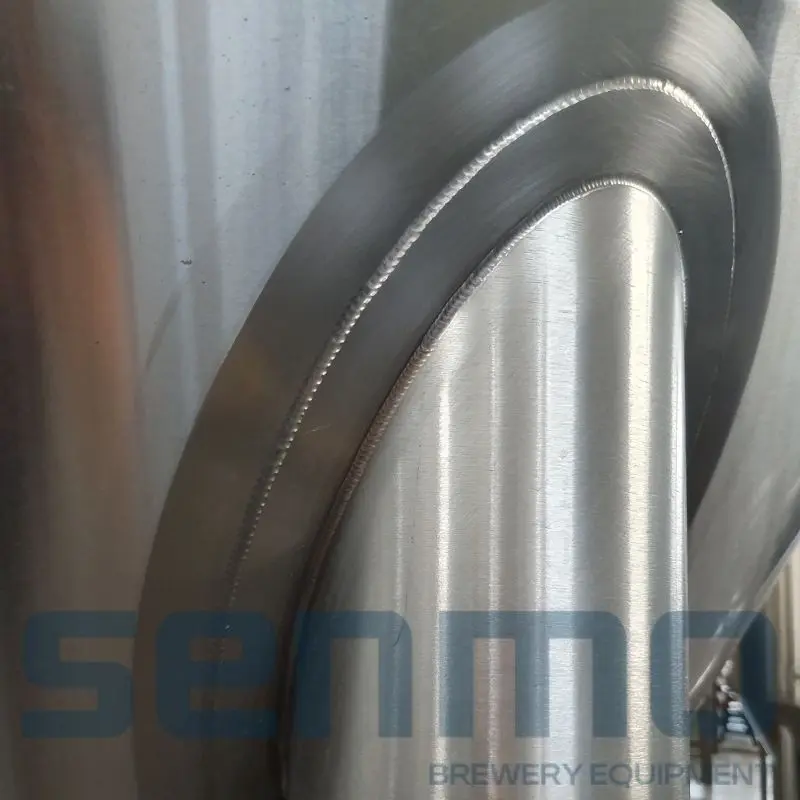
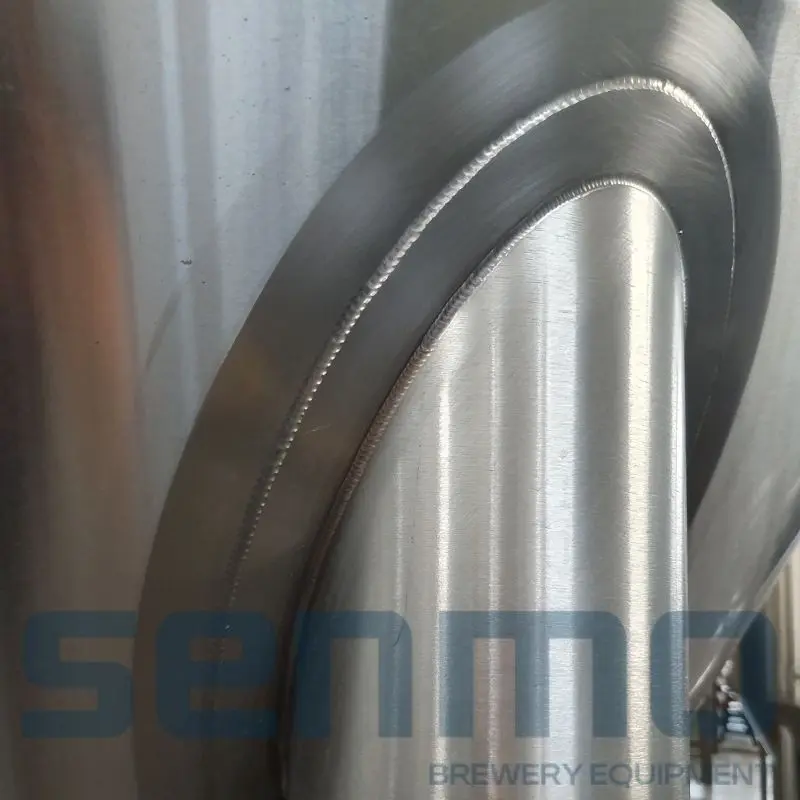
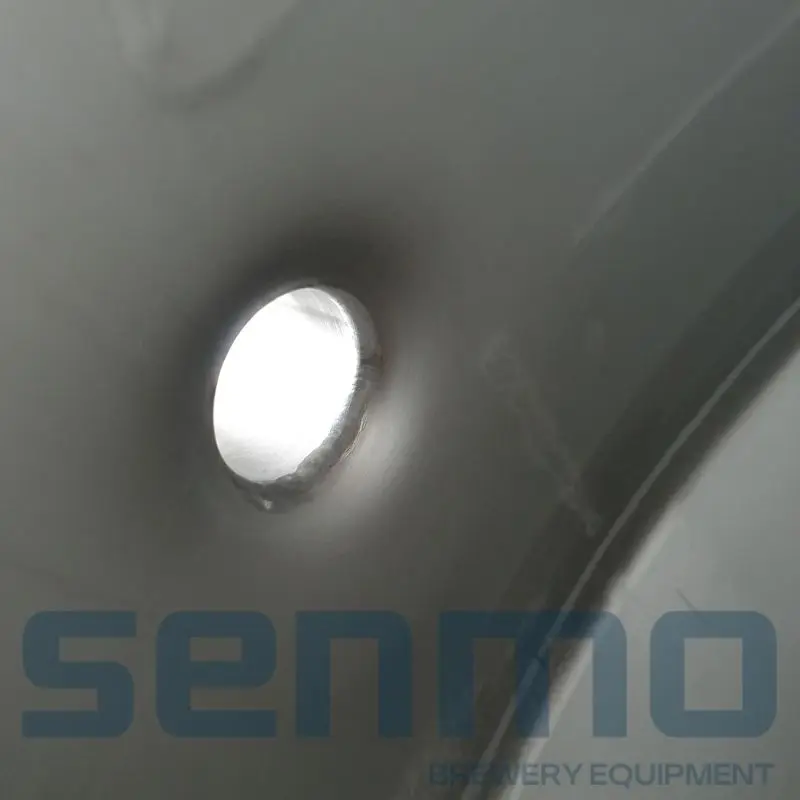
The welding and polishing are finished in high standard,we do strictly quality inspection before the beer tanks load into the containers.Below is the teating and inspection points of the tank.
Leaking test of the inner tank and cooling jackets
Pressure test of the tank and cooling jackets
Insulation inspection
Welding and polishing details inspection
10. Why Choose SENMO for 1000L Craft Beer Fermentation Tanks?
At Shandong SENMO Machinery Co., Ltd., we supply beer fermentation equipment for microbreweries and commercial brewing projects.
Our company has more than 20,000m² of workshop space, over 80 production employees, and more than 20 sales and after-sales service staff. We report nine years of brewing-equipment development and manufacturing experience and offer five major product series with more than 50 product varieties.
Our product range includes craft beer brewing equipment, beer fermentation systems, beer filling machines, beer dispensers, and beer display freezers. We have exported equipment to more than 20 countries and regions across Europe, America, Australia, and Asia.
For a 1000L craft beer fermentation tank project, our team can discuss:
Material selection: SUS304 or SUS316 stainless steel options according to the intended application.
Customized dimensions: Tank dimensions tailored to the available installation space.
Cooling and insulation: Cooling-jacket and insulation configurations based on the project requirements.
Process connections: Valves, sampling connections, temperature monitoring, and other specified accessories.
Cleaning arrangements: CIP-compatible connections and equipment according to the agreed scope.
Pressure requirements: Tank design and pressure-control specifications appropriate to the intended process and applicable requirements.
Project support: Equipment planning, manufacturing, installation arrangements, and technical service as agreed in the quotation.
We recommend providing the brewery layout, intended working volume, fermentation process, required operating pressure, cooling conditions, cleaning method, and planned production schedule before finalizing the design.
This helps ensure that the fermentation tank fits the rest of the brewery rather than being selected as an isolated piece of equipment.
11. Frequently Asked Questions About 1000L Craft Beer Fermentation Tanks
Is a 1000L fermenter suitable for a microbrewery?
Yes. A 1000L fermenter can suit a microbrewery with compatible brewhouse output and sufficient fermentation demand. The right choice depends on working volume, production frequency, tank occupancy, and the available cooling capacity.
How many gallons is a 1000L beer fermentation tank?
A 1000L tank holds approximately 264 US gallons by volume conversion. This figure does not indicate the actual quantity of beer that can be fermented or packaged.
Is SUS304 or SUS316 better for a beer fermenter?
SUS304 is commonly used in brewing equipment, while SUS316 offers greater resistance to certain corrosive environments. The most suitable material depends on the product-contact requirements, cleaning chemicals, and operating conditions.
Does SENMO's 1000L fermenter have cooling jackets?
Yes. SENMO's published product information describes dimple cooling jackets around the tank wall and cone. The precise jacket design and required cooling performance should be confirmed for the selected model.
Can the fermenter be customized?
Yes. SENMO lists customized tank dimensions and material options. Buyers can discuss the tank layout, cooling arrangements, and required accessories according to the brewery's specifications.
What does a 0.4MPa pressure test mean?
It is the pressure-test value listed on the product page. It should not be treated as the tank's allowable working pressure or design pressure. Request the complete pressure specification and applicable compliance documents before purchasing.
Can a 1000L fermentation tank be used for pressure fermentation?
Only when the vessel and all relevant components are specifically designed and approved for the intended pressure conditions. Confirm the rated pressure, safety devices, applicable codes, and operating procedures with the supplier.
How many 1000L fermenters do I need?
The required number depends on batch frequency, tank occupancy, working volume, and the production schedule. A brewery starting three batches per week with two weeks of tank occupancy would need approximately six batch-equivalent slots under a simplified scheduling model, plus any necessary buffer capacity.
What affects the price of a 1000L fermenter?
Material, tank construction, cooling jackets, insulation, pressure rating, accessories, customization, shipping, and installation requirements all affect the quotation. Compare itemized specifications rather than price alone.
Get a Quote for a 1000L Craft Beer Fermentation Tank
Choosing a 1000L craft beer fermentation tank is an investment in the consistency and flexibility of your brewery's production process.
The right tank should match your actual working volume, fermentation schedule, cooling capacity, cleaning requirements, and installation conditions. It should also provide clearly documented material and pressure specifications appropriate to the intended use.
At SENMO Machinery, we help customers discuss customized fermentation equipment for microbreweries and growing craft beer businesses.
Contact our team to request a customized 1000L beer fermenter proposal. Share your brewery layout, target working volume, beer styles, cooling requirements, and pressure specifications so we can prepare an equipment configuration for your project.
Shandong SENMO Machinery Co., Ltd.
Address: No. 1666 Xinluo Street, High-Tech Zone, Jinan, Shandong, China
Phone: +86 155 5044 9953
Email: admin@senmobrew.com
Website: www.senmobrew.com
Looking for a customized 1000L craft beer fermentation tank? Contact SENMO to discuss the right configuration for your microbrewery.


