
Choosing the right beer brewing equipment manufacturer is one of the most important decisions when starting a brewery or expanding an existing beer production facility.
A brewery is more than a collection of stainless steel tanks. It requires a coordinated production system that includes malt handling, a brewhouse, fermentation tanks, bright beer tanks, cooling equipment, cleaning systems, filtration, and packaging machinery.
However, not every brewery equipment manufacturer offers the same capabilities. Some companies specialize in large industrial brewery projects, while others focus on craft brewing systems, stainless steel fermentation tanks, process technology, or customized microbrewery equipment.
For brewery investors, brewing companies, distributors, and project contractors, understanding these differences can help reduce procurement risks and avoid purchasing equipment that does not match actual production requirements.
In this guide, we compare 10 recognized beer brewing equipment manufacturers from different markets. We examine their main product categories, technical strengths, ideal applications, and the factors buyers should consider before requesting quotations.
We also explain how to evaluate a brewery equipment supplier based on manufacturing capacity, customization, engineering support, installation, and long-term operating costs.
Planning a new brewery? Before selecting equipment, it is worth understanding the relationship between brewery capacity, fermentation capacity, utilities, and packaging requirements. Our guide on how to start a microbrewery provides a useful starting point.
How We Selected These 10 Beer Brewing Equipment Manufacturers
There is no universally accepted ranking that identifies the ten largest or objectively best brewery equipment manufacturers worldwide. Companies operate in different market segments, and their equipment portfolios are not directly comparable.
For this guide, we considered several practical factors:
Evaluation Factor | What Buyers Should Check |
|---|---|
Manufacturing capability | Factory facilities, production processes, and equipment fabrication |
Product range | Brewhouses, fermenters, bright tanks, processing and packaging equipment |
Engineering expertise | Process design, automation, and customized system integration |
Project experience | Experience in brewery installations and different production scales |
International service | Installation, commissioning, spare parts, and technical support |
Project suitability | Whether the supplier matches the buyer's capacity and investment requirements |
The companies below represent different areas of the brewery equipment industry. Some provide comprehensive brewery engineering, while others specialize in particular production processes or equipment categories.
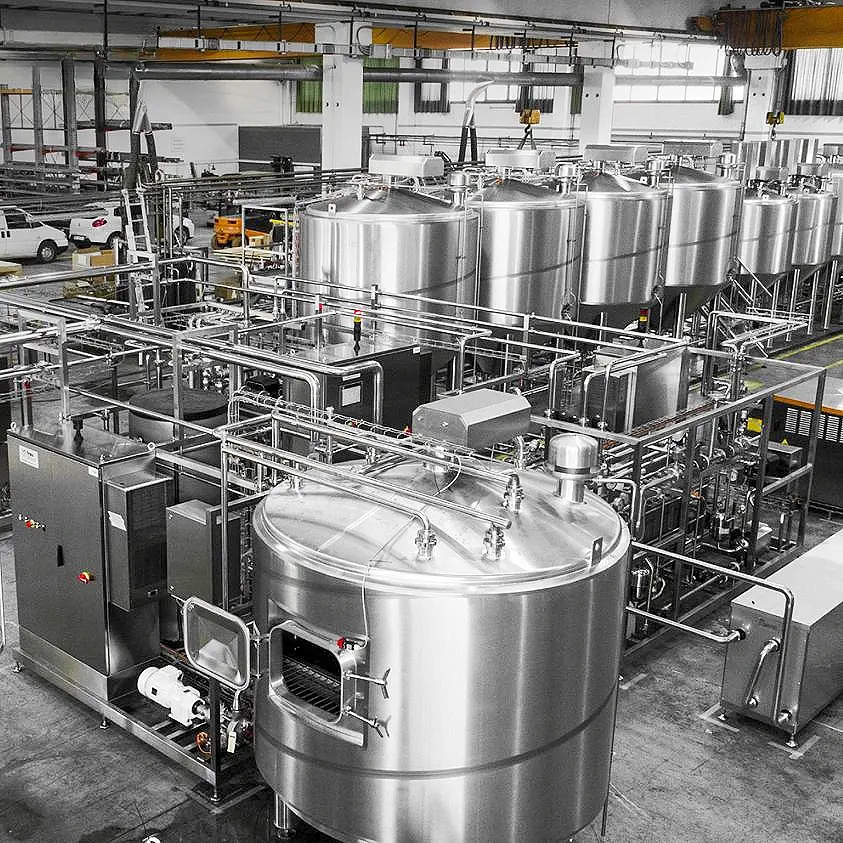
Krones AG – Germany
Main specialization: Integrated brewery process technology, filling, and packaging systems.
Headquarters: Neutraubling, Germany
Krones AG is an internationally recognized supplier of beverage production and packaging technology. Its brewery solutions cover a broad range of production stages, from malt milling and wort boiling to beer filling and packaging.
Through Steinecker, its brewery technology specialist, Krones combines process engineering with brewing expertise to serve craft breweries, traditional breweries, and large brewery groups.
Its equipment and solutions include:
Malt handling and milling systems
Brewhouses and wort production equipment
Brewery process technology
Beer filling and packaging lines
Process automation and production integration
Energy-efficient brewing solutions
Why consider Krones?
Krones is particularly relevant to breweries seeking integrated production and packaging technology. Buyers planning large commercial facilities can evaluate its ability to coordinate different production stages within one overall system.
What should buyers consider?
For smaller breweries, the investment level and technical complexity of an integrated industrial solution may exceed actual requirements. It is important to compare the proposed equipment configuration with realistic production volumes.
Official website: https://www.krones.com/
Krones describes its beer technology portfolio as extending from milling and wort boiling to filling and packaging.
2. GEA Group – Germany
Main specialization: Brewery process engineering, brewhouse systems, and cold-block technology.
Headquarters: Düsseldorf, Germany
GEA Group is a major international process engineering company serving industries including food, beverage, pharmaceutical, and other industrial sectors.
Its brewing technology covers multiple stages of the beer production process. According to GEA, its brewery systems can extend from the malt mill to the valve manifold of bright beer tanks.
Its brewery-related technologies include:
Brewhouse and mash-house systems
Wort production technology
Cold-block processing
Fermentation and beer processing equipment
Filtration and separation technology
Process automation and optimization
Why consider GEA?
GEA is worth evaluating for breweries that require extensive process engineering and integrated production equipment. Its experience in industrial processing can be relevant when designing a new brewery or optimizing an existing facility.
What should buyers consider?
Buyers should identify which equipment and engineering services are included in the quotation. A complete process solution and an individual equipment package are two different purchasing arrangements.
Official website: https://www.gea.com/
GEA's official brewing systems information highlights its coverage of the complete brewing process and its engineering capabilities.
3. Ziemann Holvrieka – Germany

Main specialization: Turnkey brewery systems, large-volume tanks, and beverage process engineering.
Headquarters: Germany
Ziemann Holvrieka has a long history in brewery and beverage equipment engineering. Founded in 1852, the company has developed into a global supplier of tanks and process solutions for the beverage and liquid food industries.
Its brewery-related capabilities include:
Turnkey brewery installations
Brewhouse systems
Large-volume fermentation tanks
Bright beer tanks
Cold-block installations
Customized engineering and project management
Why consider Ziemann Holvrieka?
The company is particularly relevant to industrial and larger commercial brewery projects that require integrated engineering, specialized vessel production, and large-capacity storage or fermentation systems.
It is also worth considering when project planning, equipment integration, and commissioning are important parts of the purchasing decision.
What should buyers consider?
Large brewery installations require detailed planning. Buyers should confirm civil engineering requirements, installation conditions, tank dimensions, utility capacity, production targets, and the scope of commissioning services before signing a contract.
Official website: https://www.ziemann-holvrieka.com/
The company describes its turnkey solutions as covering stages from feasibility studies and engineering through project execution and commissioning.
4. Alfa Laval – Sweden
Main specialization: Beer separation, heat transfer, hygienic processing, and brewery process equipment.

Headquarters: Lund, Sweden
Alfa Laval is an established supplier of heat transfer, separation, and fluid-handling technologies. Its brewery solutions support different stages of beer production, from fermentation-related operations to beer finishing.
Its brewing-related product portfolio includes:
Beer separators and centrifuges
Heat exchangers
Beer filtration technology
Dry-hopping systems
Yeast propagation and storage equipment
Tank cleaning equipment
Carbonation and blending solutions
Beer cooling and processing equipment
Why consider Alfa Laval?
Alfa Laval is especially relevant for breweries seeking to improve specific process stages, such as separation, cooling, beer recovery, filtration, and hygienic processing.
Its technologies can also be considered when upgrading an existing brewery rather than replacing the entire production system.
What should buyers consider?
Alfa Laval should not automatically be treated as a direct substitute for a turnkey brewhouse manufacturer. Buyers need to identify whether they are sourcing individual process equipment, an integrated processing package, or a complete brewery project.
Official website: https://www.alfalaval.com/
Its official brewery solutions cover technologies including centrifuges, dry-hopping, fermentation-related equipment, yeast plants, deaerated water, and beer filtration.
5. Paul Mueller Company – USA
Main specialization: Customized stainless steel brewing vessels and process tanks.

Headquarters: Missouri, USA
Paul Mueller Company is known for stainless steel processing equipment and customized vessel manufacturing.
Within the brewing industry, its products include:
Brewing kettles
Beer fermentation tanks
Bright beer tanks
Yeast tanks
Storage tanks
Pressure vessels
Customized brewery equipment
The company states that it manufactures brewing equipment in capacities ranging from 50 liters to 50,000 liters.
Why consider Paul Mueller?
Paul Mueller can be a suitable option for breweries that need customized stainless steel vessels or want to integrate specialized tanks into an existing brewery system.
Its experience in vessel design and manufacturing is particularly relevant for buyers with specific requirements involving tank dimensions, pressure, cooling, or process integration.
What should buyers consider?
Before purchasing, specify the working volume, total vessel volume, pressure rating, cooling-jacket design, insulation, internal surface finish, connections, and applicable design standards.
Compare these specifications rather than relying only on nominal tank capacity.
Official website: https://en.paulmueller.com/
Its official brewing equipment information identifies customized kettles, fermentation tanks, storage tanks, and pressure tanks as part of its brewing portfolio.
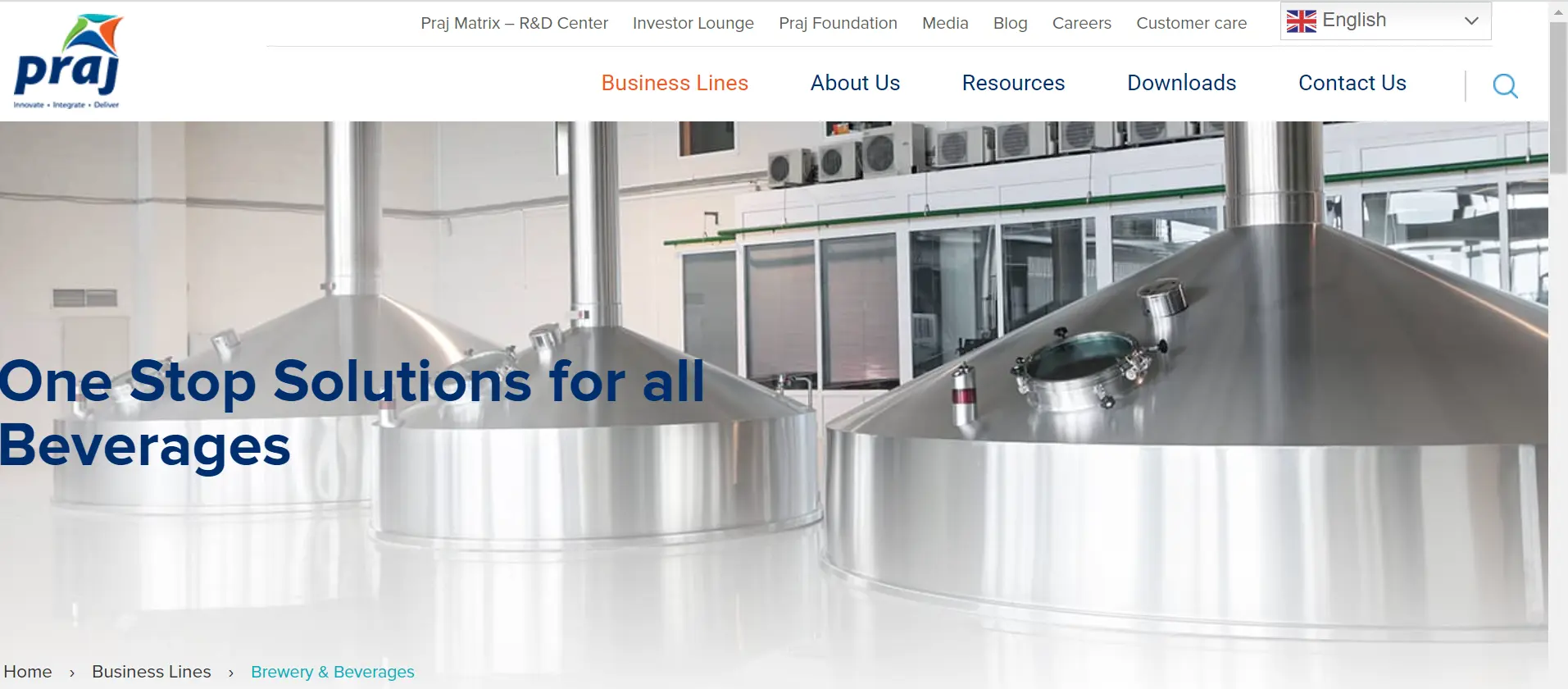
6. Praj Industries – India
Main specialization: Brewery plant engineering and integrated beverage production solutions.

Headquarters: Pune, India
Praj Industries provides engineering and technology solutions across several industrial sectors, including brewery and beverage production.
Its brewery division offers customized brewery plants and related technologies. Its services include conceptualization, technology selection, engineering, installation, and commissioning.
Its brewery-related capabilities include:
Brewery plant engineering
Wort production systems
Fermentation systems
Filtration technology
Process integration
Project installation and commissioning
Why consider Praj Industries?
Praj may be relevant to investors and brewery operators planning larger projects that require engineering coordination and integrated production solutions.
The company also has experience working with technology partners in specialized brewery processes.
What should buyers consider?
Ask for references from projects with similar production targets and process requirements. A supplier's experience in industrial engineering does not automatically mean every proposed configuration is suitable for a particular craft or commercial brewery.
Official website: https://www.praj.net/
Praj's brewery division describes its offering as including brewery plant design, engineering, installation, commissioning, and technologies for wort production, fermentation, and filtration.
7. Meura – Belgium
Main specialization: Brewhouse technology, fine milling, and mash filtration.

Headquarters: Péruwelz, Belgium
Meura is a brewery technology specialist with a history dating back to 1845. Its engineering work focuses on technologies designed to improve brewing processes, particularly in wort production and mash processing.
Its product and technology areas include:
Brewhouse systems
Fine-milling technology
Mash filtration
Continuous brewing technology
Wort production systems
Brewery process optimization
One of its recognized technology platforms is Meurabrew, which combines its brewing technologies into a continuous brewing process.
Why consider Meura?
Meura is worth considering for breweries that place particular importance on brewhouse performance, raw-material utilization, wort production, and specialized mash filtration technology.
What should buyers consider?
Its specialized process technology should be evaluated according to the brewery's production model, grain bill, operating schedule, and required output. Buyers should also verify integration with downstream fermentation and storage capacity.
Official website: https://www.meura.com/
Meura's official technology information describes its continuous brewing process and the development of technologies such as fine milling and Meurabrew.
8. Criveller Group – Canada and USA
Main specialization: Craft brewery systems, fermentation tanks, filtration, and packaging equipment.

Manufacturing locations: Ontario, Canada and California, USA
Criveller Group has been involved in beverage processing equipment since 1979. Its portfolio covers wine, beer, cider, spirits, and other food and beverage applications.
For breweries, its equipment includes:
Two-vessel brewhouses
Three-vessel brewhouses
Four-vessel brewhouses
Fermentation tanks
Bright beer tanks
Filtration equipment
Pumps
Bottling systems
Keg washing equipment
Criveller states that it has manufactured breweries since the 1970s and has installed more than 400 brewing systems worldwide.
Why consider Criveller?
The company is a relevant option for microbreweries and craft breweries seeking customized brewhouses and supporting equipment.
Its combination of processing, packaging, and technical services can also be useful for buyers planning a brewery with several production stages.
What should buyers consider?
Ask whether the quoted equipment is manufactured directly by Criveller or supplied through its partner network. Confirm the warranty, installation responsibilities, spare-parts availability, and technical support arrangements for every major component.
Official website: https://www.criveller.com/
Criveller's official website identifies its brewing equipment manufacturing experience, brewhouses, fermentation tanks, filtration, and packaging solutions.
9. ICC Northwest – USA
Main specialization: Custom stainless steel tanks, mixers, reactors, and process systems.
Location: Canby, Oregon, USA
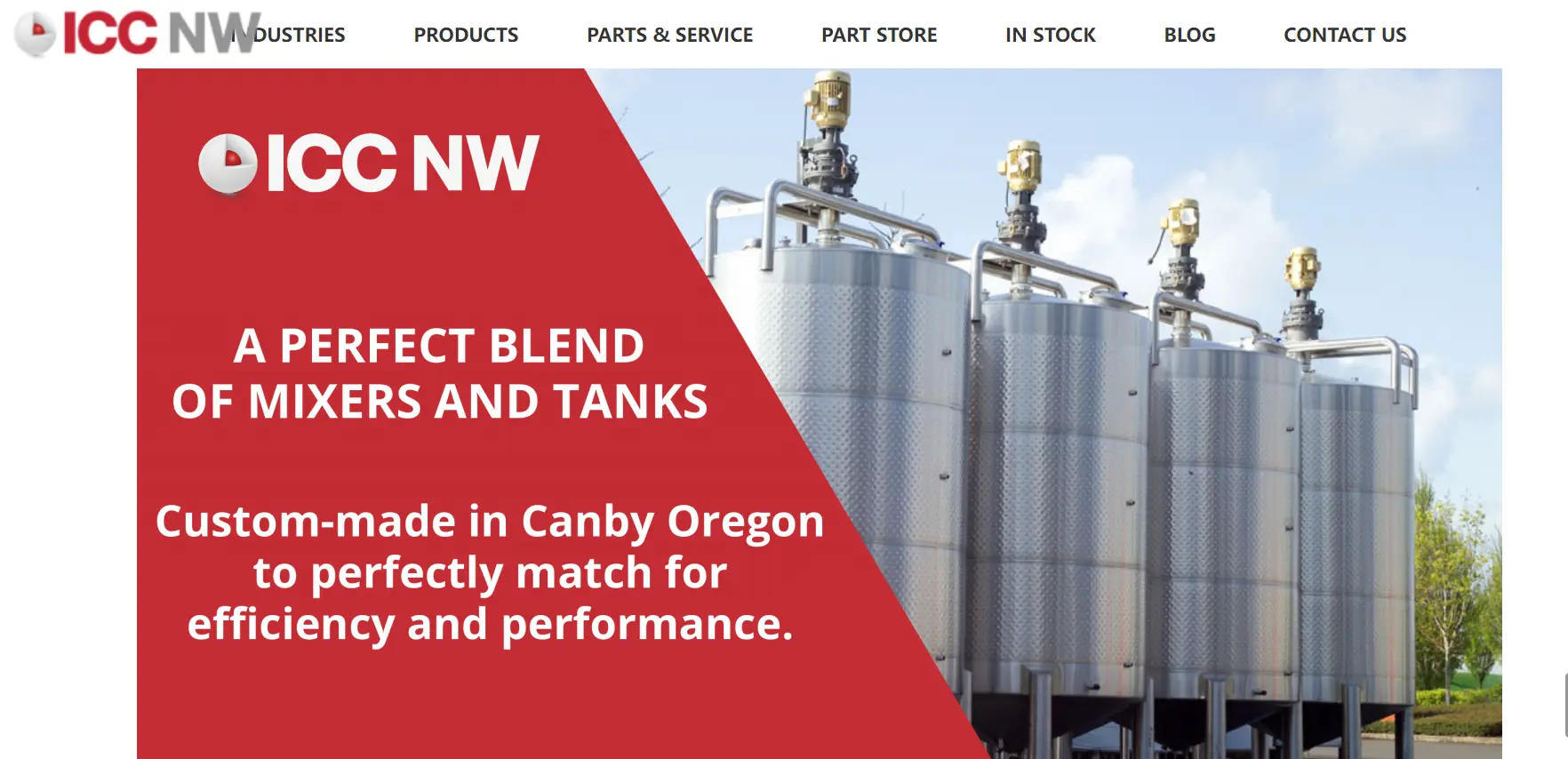
ICC Northwest specializes in custom manufacturing stainless steel equipment for industries including brewing, distilling, pharmaceutical production, and alternative energy.
Its capabilities include:
Stainless steel process tanks
Custom storage vessels
Mixers and reactors
Automated turnkey process systems
Equipment installation
Retrofitting services
Replacement parts
Why consider ICC Northwest?
ICC Northwest may be suitable for breweries that need customized stainless steel equipment or specialized process systems rather than a standardized brewery package.
Its custom manufacturing approach is relevant when equipment dimensions, vessel design, or process requirements cannot be met by a standard product configuration.
What should buyers consider?
Clarify the extent of its brewery-specific engineering experience, process design responsibilities, and integration capabilities. Ask for technical references that match the intended application.
Official website: https://www.icc-inc.net/about/northwest/
ICC Northwest's official company page identifies its custom stainless steel equipment manufacturing, automated turnkey systems, installation, and retrofitting services.
10. SENMO Machinery – China
Main specialization: Microbrewery equipment, commercial brewery systems, fermentation tanks, and turnkey brewery projects.
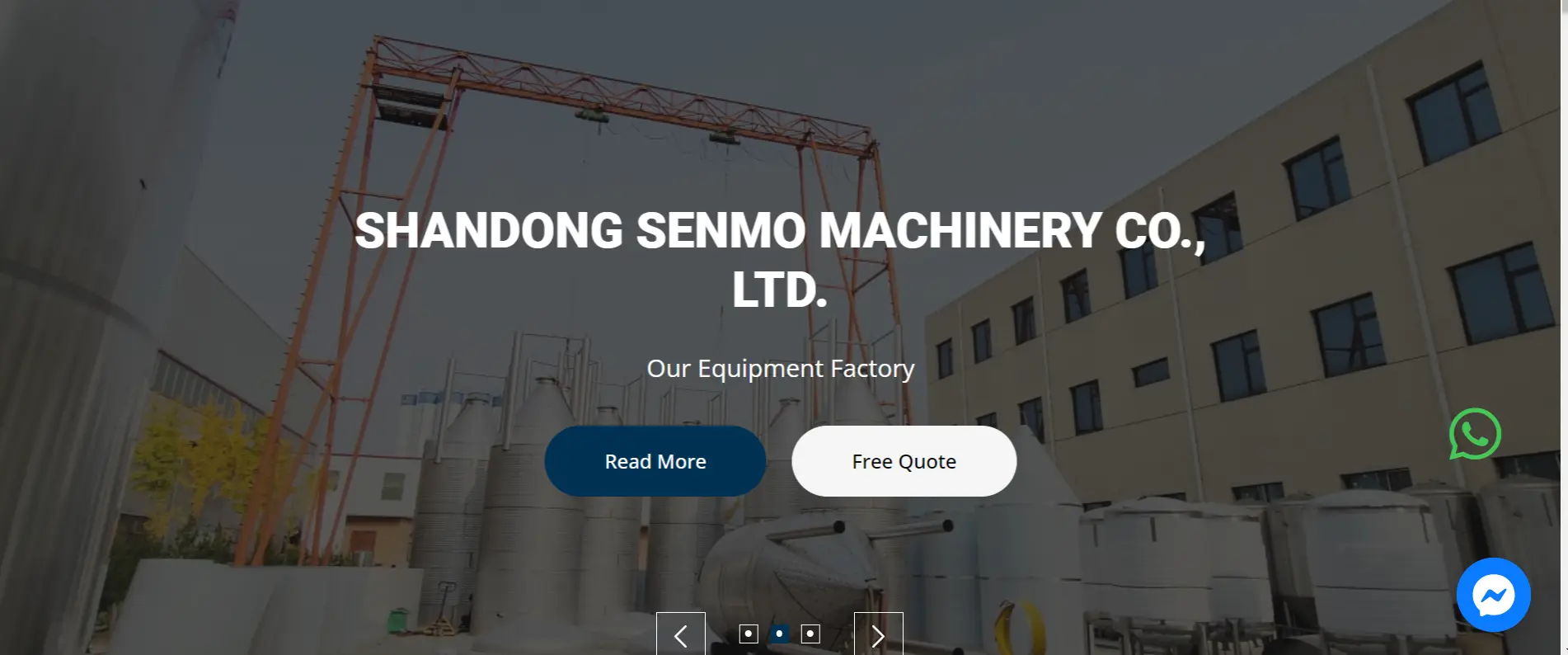
Location: Jinan, Shandong, China
SENMO Machinery is a Chinese brewery equipment manufacturer serving microbreweries, brewpubs, hotels, restaurants, and commercial brewery projects.
The company operates a manufacturing workshop of more than 20,000 m² and reports having more than 80 production employees and more than 20 sales and after-sales service team members.
Its equipment portfolio covers several major brewery production categories:
Craft beer brewing equipment
Microbrewery systems
Medium and large brewery equipment
Beer fermentation tanks
Bright beer tanks
Beer filling machines
Brewery accessories
Distillery equipment
SENMO also provides turnkey project services, including research and development, experimental work, process and equipment design, manufacturing, installation, and technical process training.
Why consider SENMO Machinery?
SENMO is worth evaluating for buyers looking for customized brewery systems, particularly microbrewery and commercial craft beer projects.
Instead of selecting each machine independently, buyers can discuss a coordinated configuration covering the brewhouse, fermentation cellar, cooling system, CIP, and packaging equipment.
For example, a brewery project may start with a 500L commercial beer brewing system for a brewpub or small commercial facility. Larger production requirements can be evaluated through a 1000L beer brewery equipment configuration.
For projects requiring a complete equipment package, SENMO also offers turnkey 1000L craft beer brewery machinery.
What should buyers consider?
A brewery equipment manufacturer should be evaluated against the actual project specification, not simply its advertised capacity.
Before ordering from SENMO or any other manufacturer, buyers should confirm:
Brewhouse batch size and vessel configuration
Fermentation and bright tank capacity
Stainless steel material and surface finish
Heating and cooling requirements
Control system and automation level
Electrical standards and local compliance requirements
Packaging equipment configuration
Delivery schedule and installation arrangements
Spare parts and after-sales service
Official website: https://www.senmobrew.com/
SENMO's official company information describes its manufacturing facility, product categories, international project experience, and turnkey services.
Comparison of the 10 Beer Brewing Equipment Manufacturers
The following table summarizes the main differences to help buyers narrow down their supplier shortlist.
Manufacturer | Country | Main Expertise | Suitable Project Type |
|---|---|---|---|
Krones | Germany | Integrated brewing and packaging technology | Industrial and large commercial breweries |
GEA Group | Germany | Brewery process engineering | Large and medium-sized breweries |
Ziemann Holvrieka | Germany | Turnkey plants and large tanks | Industrial and large-scale breweries |
Alfa Laval | Sweden | Separation, heat transfer, and processing | Breweries upgrading process equipment |
Paul Mueller | USA | Customized stainless steel tanks | Craft and commercial breweries |
Praj Industries | India | Brewery engineering and integrated plants | Larger brewery projects |
Meura | Belgium | Brewhouse and mash filtration technology | Breweries with specialized wort production needs |
Criveller Group | Canada/USA | Craft brewery systems and tanks | Microbreweries and craft breweries |
ICC Northwest | USA | Custom stainless steel process equipment | Customized vessel and process projects |
SENMO Machinery | China | Microbrewery and commercial brewery systems | Brewpubs, microbreweries, and commercial projects |
Important: This comparison evaluates the companies by their publicly described areas of expertise. It is not an independently audited ranking of annual revenue, market share, or worldwide installation volume.
What Equipment Does a Commercial Brewery Actually Need?
Before choosing a manufacturer, buyers should understand the major components of a brewery production system.
The correct configuration depends on batch size, production frequency, beer styles, fermentation time, and packaging requirements.
1. Malt Milling and Handling System
The milling system prepares malt for mashing.
Typical equipment includes:
Malt mills
Grain hoppers
Malt conveyors
Screw augers
Grist cases
Grain handling systems
The objective is to achieve a suitable grain crush for the brewing process.
An unsuitable grain crush can affect lautering performance and extract efficiency.
2. Brewhouse System
Make Sure Your Ears Work: An Inside Look with Martin Bills of Pelican Brewing | Craft Beer & Brewing
The brewhouse is responsible for mashing, lautering, wort boiling, and whirlpool separation.
Typical configurations include:
Configuration | Typical Arrangement | Application |
|---|---|---|
2-vessel | Mash/lauter tun + kettle/whirlpool | Small breweries and compact projects |
3-vessel | Mash tun + lauter tun + kettle/whirlpool | Growing commercial breweries |
4-vessel | Separate vessels for each major operation | Higher production flexibility |
For buyers comparing compact and commercial systems, SENMO provides information on its 1000L brewhouse equipment.
The correct vessel configuration should be based on brewing frequency, available floor space, heating method, and expected daily production.
3. Fermentation Tanks and Bright Beer Tanks
5HL 10HL Micro brewery turnkey system
Fermentation capacity is just as important as brewhouse capacity.
A brewery may have a large brewhouse but insufficient fermentation space. This can limit production regardless of how quickly the brewhouse operates.
Common vessel types include:
Cylindrical-conical fermenters
Unitanks
Bright beer tanks
Yeast storage tanks
Horizontal conditioning tanks
For example, a 500L stainless steel beer fermentation system can be considered for smaller production configurations.
Bright beer tanks are used for conditioning, carbonation, storage, and preparing beer for packaging. SENMO's 500L horizontal bright beer tanks are one example of equipment for this stage.
4. Cooling and CIP Cleaning Systems
Temperature control and cleaning are essential for stable brewery operations.
A commercial brewery may require:
Glycol water tanks
Glycol chillers
Cooling pumps
Cooling pipelines
CIP tanks
Cleaning pumps
Automated valves
Cleaning control systems
The cooling system must be designed around the total connected tank capacity and operating conditions.
A CIP system allows tanks and pipelines to be cleaned without dismantling the entire production system.
For smaller brewery projects, SENMO provides a 200L brewery removable CIP unit.
5. Beer Filling and Packaging Equipment
ProFill Solutions - Automatic & Commercial Beer Can Filler | ProBrew
Packaging equipment depends on how the brewery sells its beer.
Common options include:
Beer keg filling machines
Bottle filling machines
Beer canning machines
Keg washing machines
Labeling equipment
Packaging conveyors
For breweries targeting retail distribution or wholesale customers, a suitable filling line should be included in the original equipment plan.
SENMO offers an automatic beer can filling machine for microbreweries.
How to Choose the Right Beer Brewing Equipment Manufacturer
A well-known brand is not automatically the best supplier for every project.
A suitable manufacturer should offer the equipment, technical specifications, and service capabilities needed for your actual business model.
1. Start With Your Required Production Capacity
Define the production volume before requesting equipment quotations.
Useful information includes:
Target annual beer production
Expected batches per day
Brewing days per week
Fermentation time
Number of beer styles
Packaging volume
Expected future expansion
For example, a brewpub producing beer mainly for on-site consumption may have different requirements from a production brewery supplying distributors.
2. Check the Manufacturer's Real Production Capability
When evaluating a supplier, ask whether it owns the manufacturing facility or outsources major parts of the production process.
Useful questions include:
Can you provide recent factory photos or arrange a factory visit?
Which equipment is manufactured in-house?
What welding and fabrication methods are used?
How are tanks tested and inspected?
Can you provide production drawings?
Can you show similar completed projects?
A manufacturer's factory capability is particularly important for customized tanks and complete brewery systems.
3. Compare Equipment Specifications, Not Only Quotations
Two brewery equipment quotations may look similar while containing very different configurations.
Compare:
Specification | What to Confirm |
|---|---|
Material | Stainless steel grade and thickness |
Tank capacity | Working volume and total volume |
Heating | Steam, electric, or direct-fire heating |
Cooling | Jacket design and glycol requirements |
Insulation | Material and thickness |
Internal finish | Surface finish and hygienic requirements |
Welding | Fabrication and inspection procedures |
Control | Manual, semi-automatic, or PLC-based |
Connections | Sanitary fittings and pipe standards |
Testing | Pressure and functional testing requirements |
For example, a 1,000L brewhouse quotation should clearly identify the vessel arrangement, heating method, hot water capacity, pumps, heat exchanger, control system, and included auxiliary equipment.
4. Evaluate Fermentation Capacity Separately
Fermentation tanks determine how much wort can be processed and held during the fermentation and conditioning stages.
A practical planning calculation is:
[ ext{Required Fermentation Capacity} approx ext{Daily Wort Production} imes ext{Average Tank Occupancy Days} ]
This is a simplified estimate. Actual planning must also include tank headspace, cleaning time, beer styles, production scheduling, and tank availability.
Do not select a brewery based only on the brewhouse batch size.
5. Confirm Installation and After-Sales Services
International equipment purchasing involves more than manufacturing and delivery.
Confirm whether the supplier offers:
Installation guidance
Overseas engineer services
Commissioning support
Operator training
Electrical documentation
Spare parts
Maintenance guidance
Warranty terms
These details should be documented in the contract.
6. Consider Total Project Investment
The purchase price of the equipment is only one part of the total brewery investment.
Other costs may include:
International freight
Import duties and taxes
Installation labor
Building preparation
Electrical work
Drainage and plumbing
Steam and refrigeration utilities
Packaging machinery
Local compliance work
Initial ingredients and working capital
A low quotation may become expensive if essential equipment or services are excluded.
Why Consider a Chinese Beer Brewing Equipment Manufacturer?
China has become an important sourcing market for brewery equipment, offering buyers access to various equipment manufacturers and customized production solutions.
However, buyers should distinguish between factories with genuine engineering and manufacturing capabilities and trading companies that primarily resell equipment.
A Chinese brewery equipment supplier may be worth considering when buyers need:
Customized vessel dimensions
Flexible brewhouse configurations
Complete brewery equipment packages
OEM equipment manufacturing
Integrated fermentation and cooling systems
Direct communication with the manufacturer
Project-specific engineering
The appropriate approach is to evaluate each company based on manufacturing evidence, technical specifications, inspection procedures, installation arrangements, and similar project references.
Price should be considered together with equipment quality, engineering support, and long-term serviceability.
Why Choose SENMO Machinery for Brewery Equipment?
Microbrewery brewing equipment 20hl 2000L mash tun - Senmo Machinery
Shandong SENMO Machinery Co., Ltd. is based in Jinan, Shandong, China. The company focuses on the design and manufacture of brewery equipment for microbreweries, brewpubs, hotels, restaurants, and commercial beer production facilities.
According to SENMO's company information, its manufacturing workshop covers more than 20,000 m², with over 80 production employees and more than 20 sales and after-sales service team members.
The company provides equipment design, manufacturing, installation support, and technical process training for brewery projects.
A Broad Range of Brewery Equipment
SENMO's product portfolio includes:
Equipment Category | Main Products |
|---|---|
Brewhouse | Mash tuns, lauter tuns, kettles, whirlpools |
Fermentation | Conical fermenters and fermentation systems |
Bright beer storage | Horizontal and vertical bright beer tanks |
Cooling | Glycol tanks, chillers, and cooling accessories |
Cleaning | CIP stations and cleaning equipment |
Packaging | Beer canning and filling machines |
Auxiliary equipment | Pumps, pipes, valves, and controls |
Customized Equipment for Different Production Scales
Not every brewery needs the same production capacity.
A new brewpub may prioritize a compact brewing system, while an established commercial brewery may need a larger brewhouse, additional fermentation tanks, and packaging equipment.
SENMO can configure systems around:
Production volume
Brewery layout
Vessel quantities
Beer styles
Heating method
Cooling capacity
Automation requirements
Packaging method
Future expansion
For customers planning larger commercial installations, SENMO also provides complete 2000L commercial beer brewery equipment.
For more specialized brewery operations, yeast management can also be considered as part of the overall process design. Explore SENMO's beer yeast propagation system.
From Equipment Manufacturing to Project Support
A brewery project involves much more than supplying individual machines.
The equipment supplier should understand how the brewhouse, fermenters, bright beer tanks, cooling, CIP, utilities, and packaging systems work together.
SENMO provides project-oriented support to help customers develop equipment configurations according to their intended production and installation conditions.
For a new brewery, we recommend preparing the following information before requesting a quotation:
Target production capacity
Number of brewing batches per day
Required beer styles
Available building dimensions
Preferred brewhouse configuration
Fermentation tank quantities
Heating and cooling requirements
Packaging method
Destination country
Voltage and frequency requirements
Approximate project budget
With this information, the supplier can prepare a more relevant equipment proposal rather than providing a generic price for an incomplete system.
To learn more about the manufacturer and its services, visit SENMO Machinery.
Frequently Asked Questions About Beer Brewing Equipment Manufacturers
1. Who is the largest beer brewing equipment manufacturer in the world?
There is no single universally accepted ranking that identifies the largest manufacturer across every brewery equipment category.
Companies such as Krones, GEA, and Ziemann Holvrieka have extensive capabilities in industrial brewery process technology and large-scale projects. Other companies specialize in tanks, filtration, or craft brewery systems.
The right supplier depends on the intended production scale and equipment requirements.
2. What is the difference between a brewery equipment manufacturer and a brewery equipment supplier?
A manufacturer designs or produces equipment, sometimes operating its own fabrication facility.
A supplier may manufacture equipment directly, distribute products from other manufacturers, or combine equipment from several brands into one project package.
Buyers should confirm who is responsible for manufacturing, quality control, warranty, and after-sales service.
3. Which manufacturer is suitable for a microbrewery?
The best choice depends on the required batch capacity, available building space, budget, beer styles, and expected production schedule.
Companies such as Criveller and SENMO offer solutions relevant to craft and microbrewery projects. Other manufacturers may be more suitable for specific equipment or larger industrial installations.
4. What equipment is required to start a commercial brewery?
A typical commercial brewery requires:
Malt milling equipment
Brewhouse
Fermentation tanks
Bright beer tanks
Glycol cooling system
CIP cleaning system
Pumps and sanitary pipelines
Electrical control system
Beer filling or packaging equipment
The final equipment list depends on the production model and packaging requirements.
5. What should I check before ordering brewery equipment from China?
Confirm the manufacturer's factory, technical specifications, material grade, tank fabrication, welding, polishing, pressure testing, electrical configuration, and applicable documentation.
Also confirm installation services, warranty conditions, delivery terms, and spare-parts availability.
6. How do I compare quotations from different brewery equipment manufacturers?
Compare quotations line by line.
Check tank quantities, vessel capacities, materials, heating methods, insulation, cooling systems, control systems, pumps, valves, packaging equipment, installation, and shipping terms.
A quotation with a lower price may exclude equipment that another supplier has already included.
7. Can one manufacturer supply a complete turnkey brewery?
Yes. Some brewery equipment manufacturers provide coordinated solutions covering design, manufacturing, installation, and commissioning.
However, the precise scope varies by supplier. Ask for a detailed equipment list, process flow diagram, layout drawing, and service responsibility schedule.
8. How much does commercial brewery equipment cost?
The investment depends on production capacity, vessel quantity, material specifications, automation, heating method, cooling capacity, and packaging configuration.
A small brewpub and a large commercial brewery have very different equipment requirements. Buyers should request a quotation based on a complete project specification instead of comparing prices for individual tanks alone.
Conclusion: Choose a Brewery Equipment Manufacturer Based on Your Project
Selecting a suitable beer brewing equipment manufacturer requires more than comparing company histories or product catalogs.
Krones, GEA, and Ziemann Holvrieka offer broad capabilities in brewery process engineering and integrated production systems. Alfa Laval and Meura focus on specialized process technologies, while Paul Mueller and ICC Northwest are relevant to customized stainless steel equipment. Criveller, Praj, and SENMO provide other options for different project and production requirements.
The most suitable supplier is the one that can meet your production capacity, technical specifications, budget, installation requirements, and long-term operating needs.
Before making a final decision, compare at least three quotations using the same equipment configuration and service scope.
Planning a new microbrewery, brewpub, or commercial brewery?
SENMO Machinery can help you evaluate the brewhouse, fermentation capacity, cooling system, CIP equipment, and packaging configuration according to your project requirements.
Contact SENMO Machinery to discuss your brewery project and request a customized equipment proposal.


